
Session analysis
Every round ends with a report you can check.
This is the real report of one recorded Voice2Evolve round on a supplier quotation. Read it the way a buyer would: the verdict first, then the reasons, then the evidence behind them.
At a glance
- Turnaround
- About a minute
- The report is generated as soon as the session ends and is typically ready within 60 seconds.
- Take it with you
- Transcript and PDF
- Every report can be exported as a PDF, and the full transcript can be downloaded alongside it.
- Where it lives
- Your account, your retention
- Transcripts are stored encrypted in your account under your retention settings. Voice audio is not stored.
The report, section by section
Read one report from the top.
01 · 30-second view
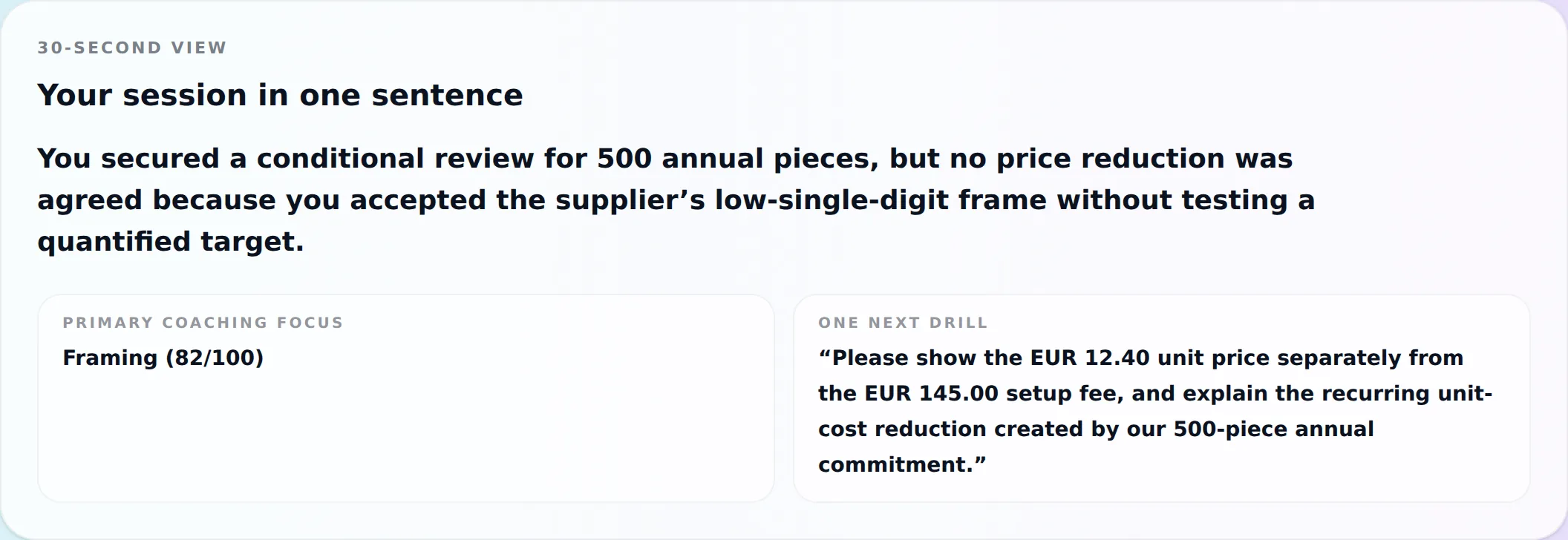
The verdict comes first, in one sentence.
A buyer with two minutes can stop here. It says what happened and why, names the behaviour to work on, and gives one phrase to rehearse next.
From the report You secured a conditional review for 500 annual pieces, but no price reduction was agreed because you accepted the supplier’s low-single-digit frame without testing a quantified target.
02 · Negotiation summary
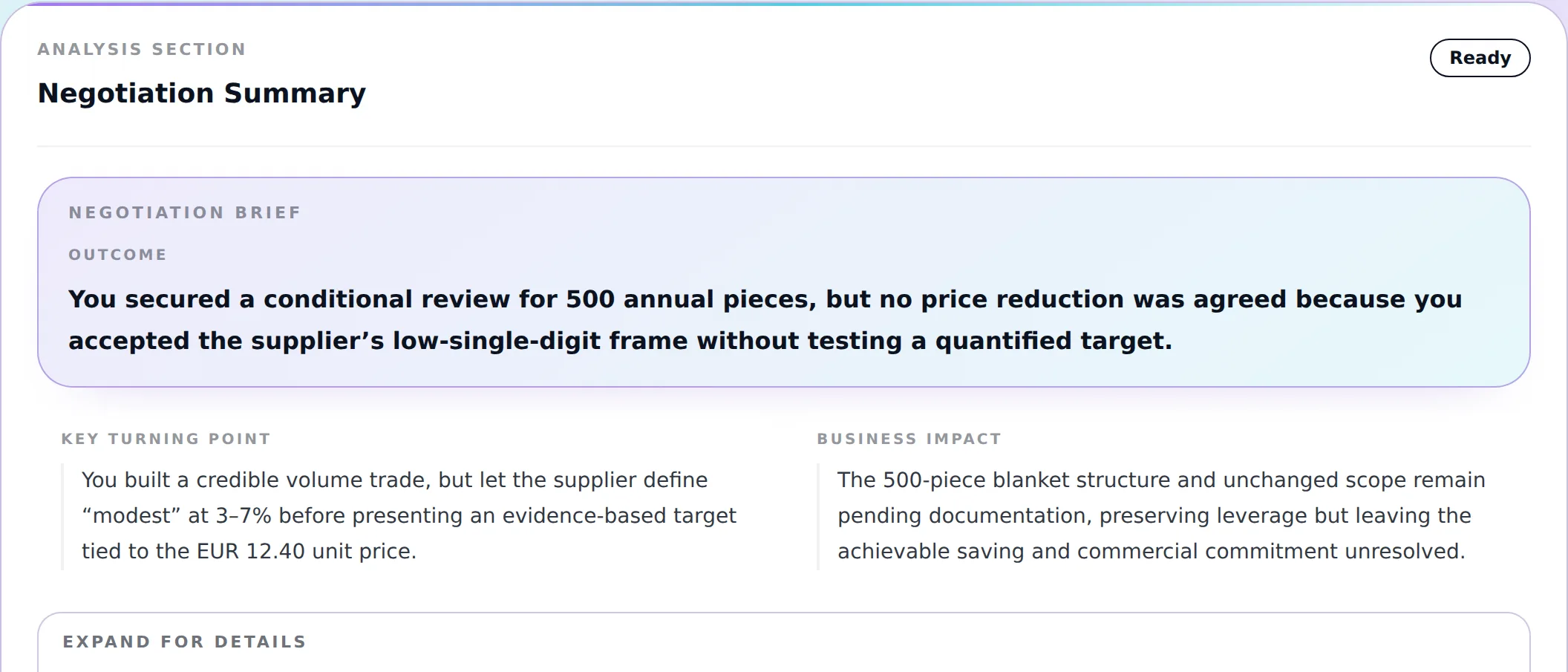
What was won, and what was left on the table.
The summary separates the outcome from its turning point and its business impact. In this round the volume trade was credible, but the supplier set the meaning of “modest” before a quantified target was on the table.
From the report You built a credible volume trade, but let the supplier define “modest” at 3–7% before presenting an evidence-based target tied to the EUR 12.40 unit price.
03 · Scored behaviours
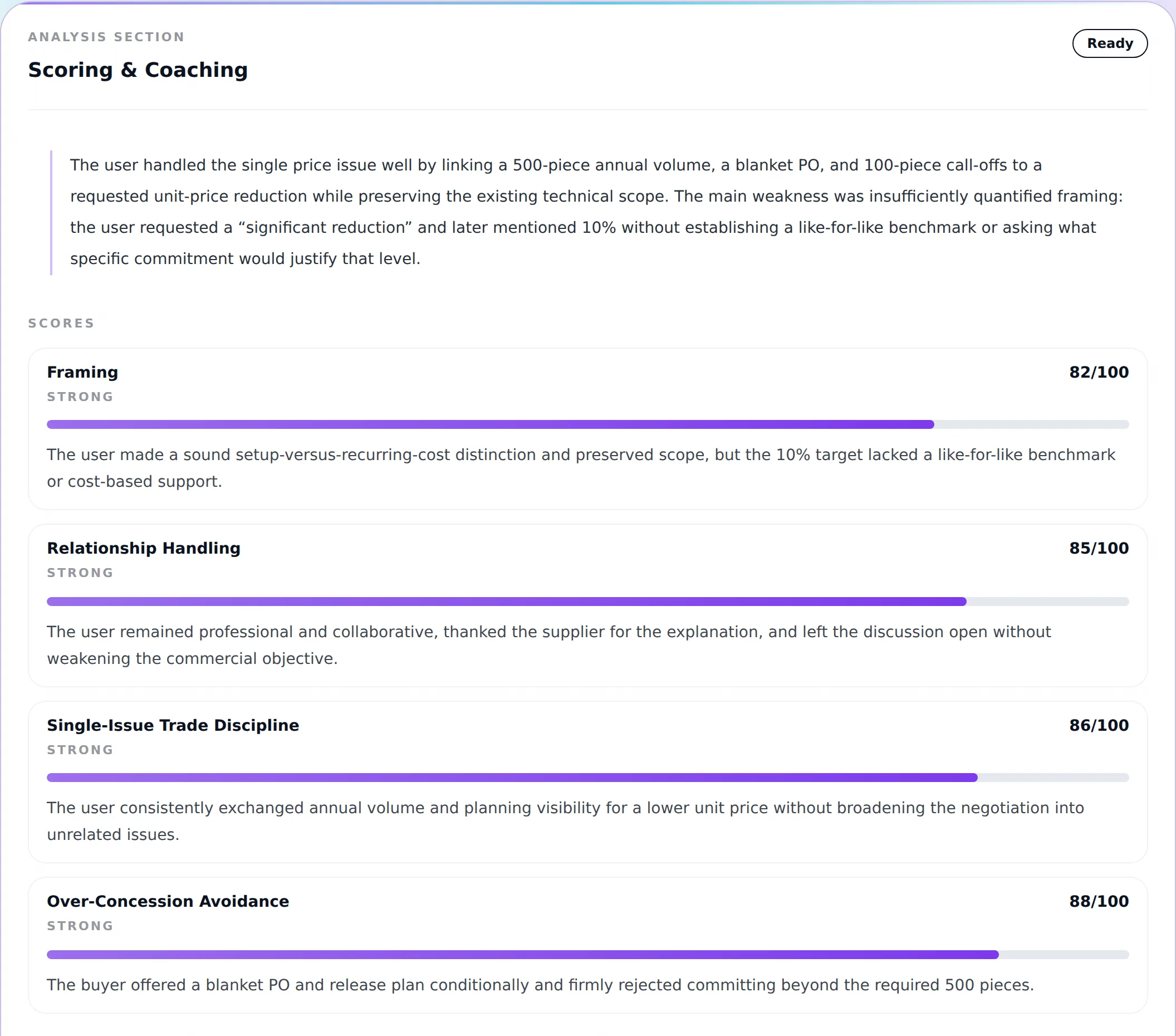
Every score comes with its reason.
Behaviours are scored out of 100 and banded, and each score carries a sentence of evidence from the conversation. Framing is the lowest here at 82, Over-Concession Avoidance the highest at 88, and both are explained.
From the report The main weakness was insufficiently quantified framing: the user requested a “significant reduction” and later mentioned 10% without establishing a like-for-like benchmark or asking what specific commitment would justify that level.
04 · Critical moments
Turn by turn: what happened, and what should have.
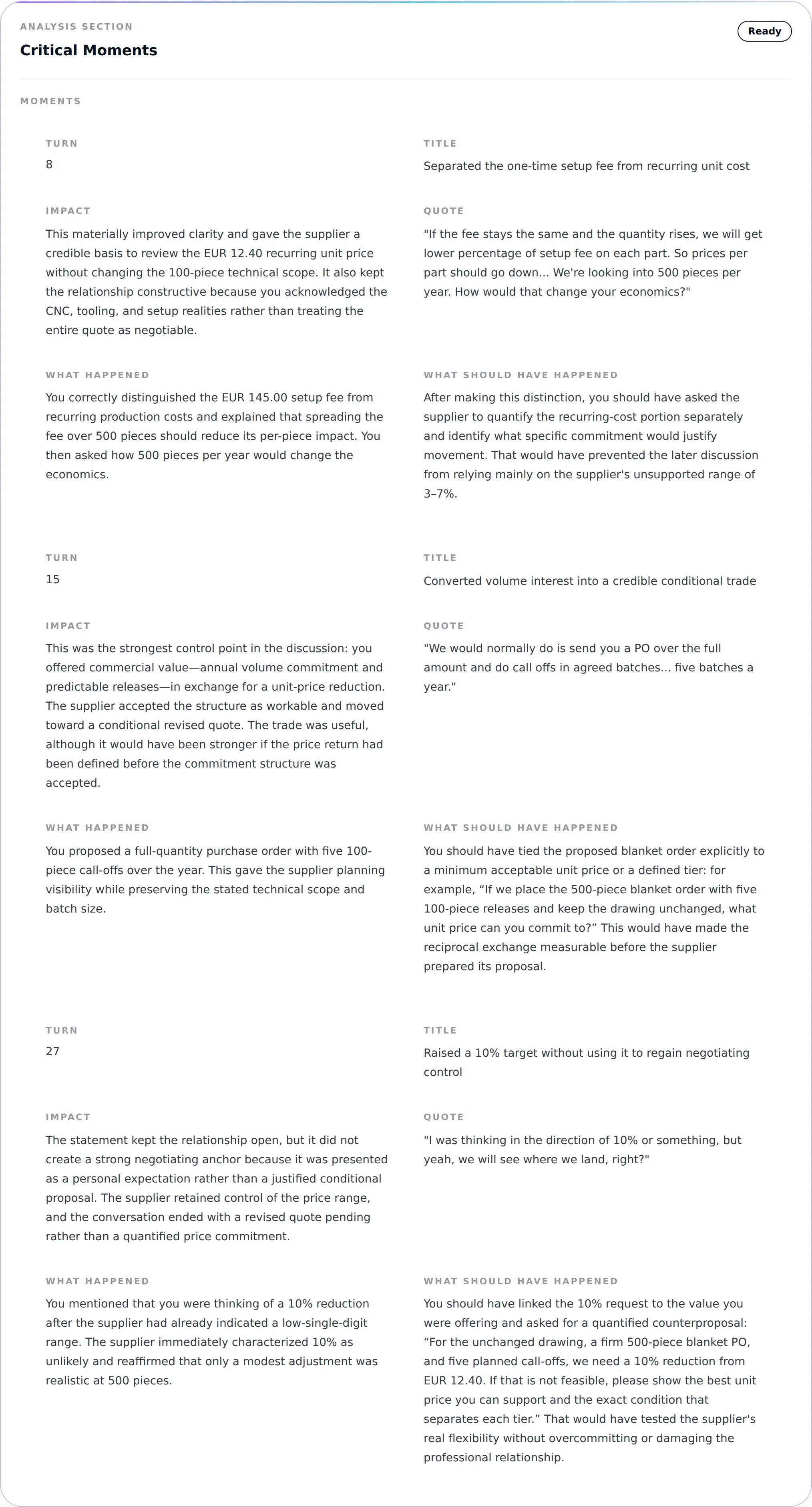
Moments that moved the outcome are pinned to a turn of the conversation, with the words spoken, the impact, what you did and what a stronger move would have been. This round surfaced three.
From the report This materially improved clarity and gave the supplier a credible basis to review the EUR 12.40 recurring unit price without changing the 100-piece technical scope.
05 · Evidence trail
Every conclusion points back to what was said.
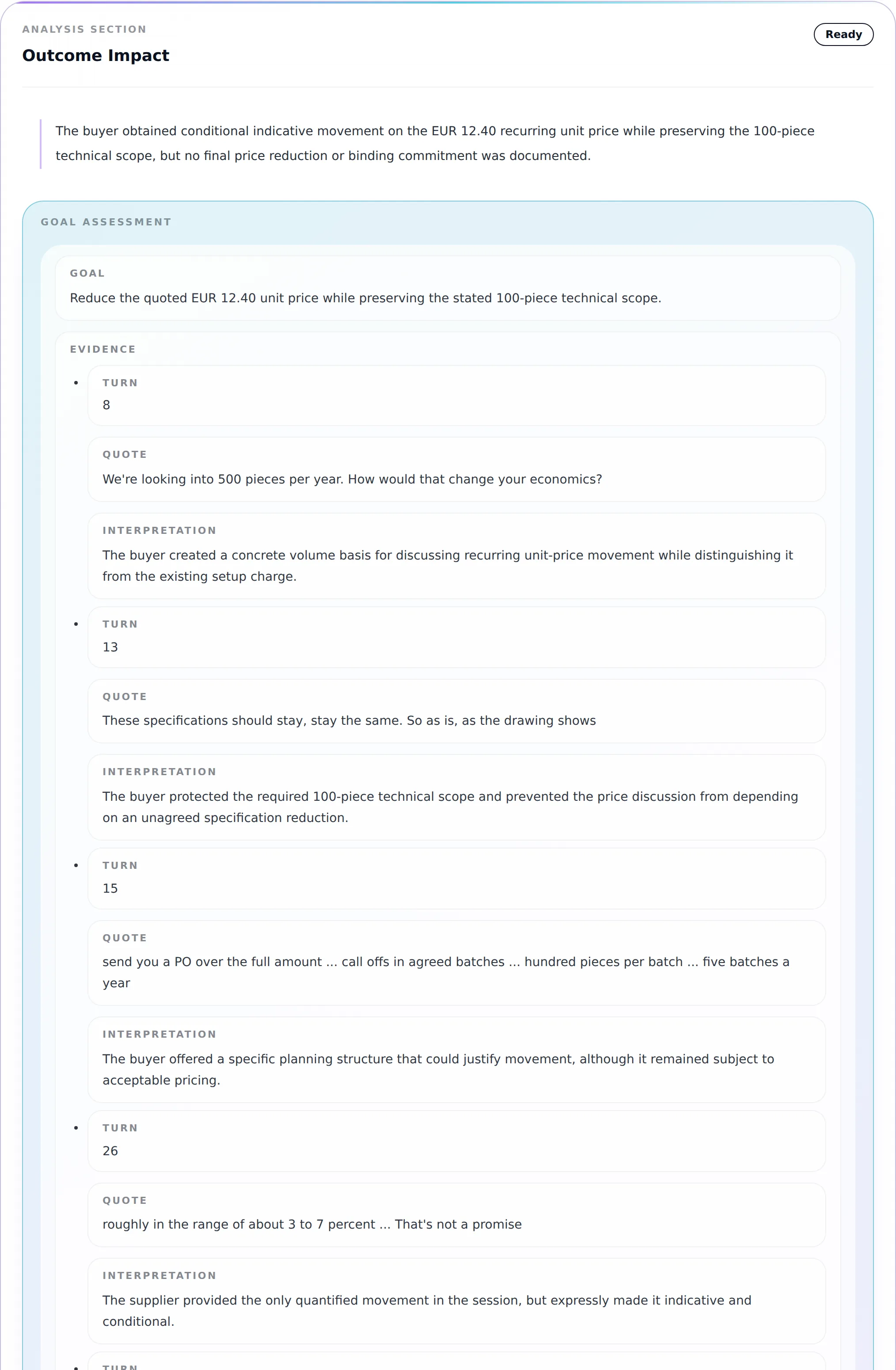
The outcome assessment sets the goal against evidence: the turn, the exact words and an interpretation. A reviewer can check any conclusion against the conversation instead of taking the report on trust.
From the report The supplier provided the only quantified movement in the session, but expressly made it indicative and conditional.
06 · Reading the other side
What the supplier signalled, and how sure the report is.
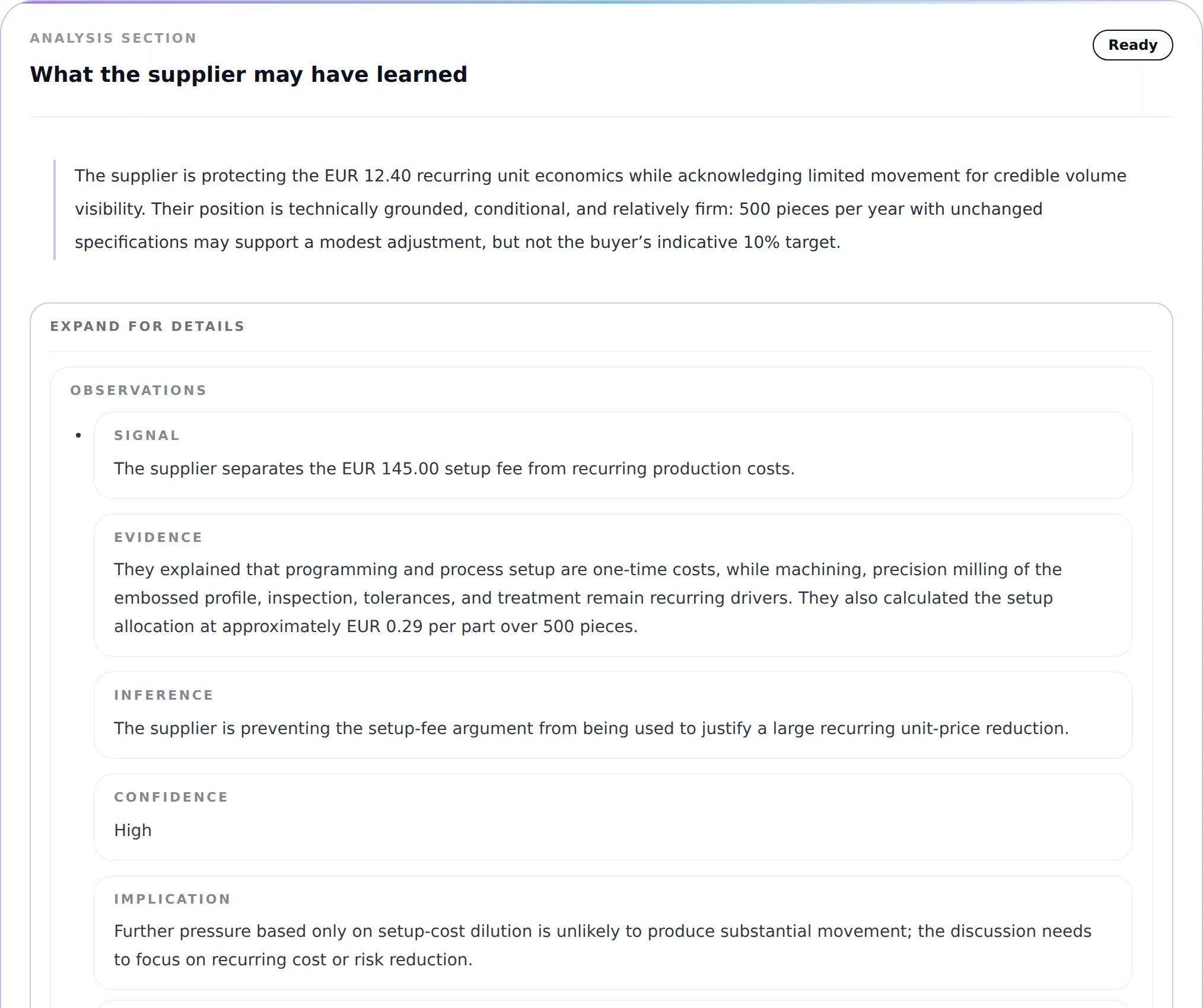
For each observation the report separates the signal, the evidence, the inference and the implication, and states a confidence. What is inferred is labelled as inferred.
From the report The 3%–7% range is an indicative supplier position, not an agreed price. The buyer should treat it as an opening signal to test, not as proof that the final offer will reach the top of the range.
07 · Delivery signals
How it sounded, not only what was said.
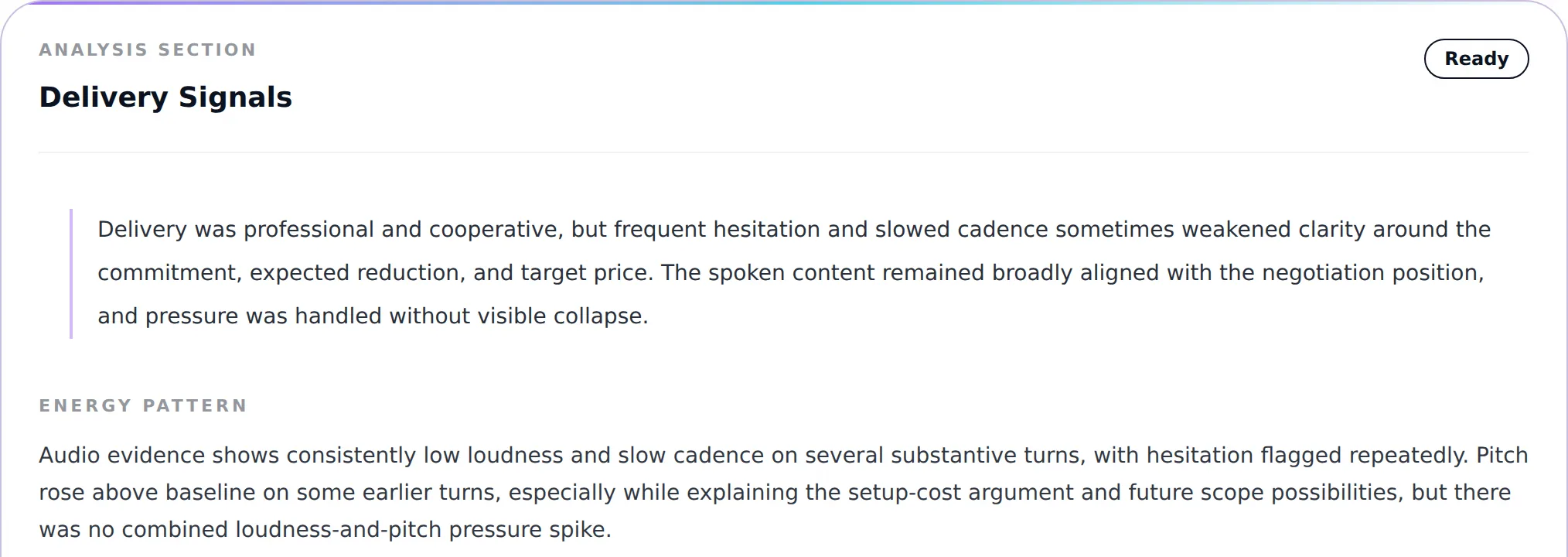
Delivery signals come from the audio: energy, pace and hesitation, linked to turns of the conversation. They describe how delivery affected clarity. They are not a verdict on the person.
From the report Delivery was professional and cooperative, but frequent hesitation and slowed cadence sometimes weakened clarity around the commitment, expected reduction, and target price.
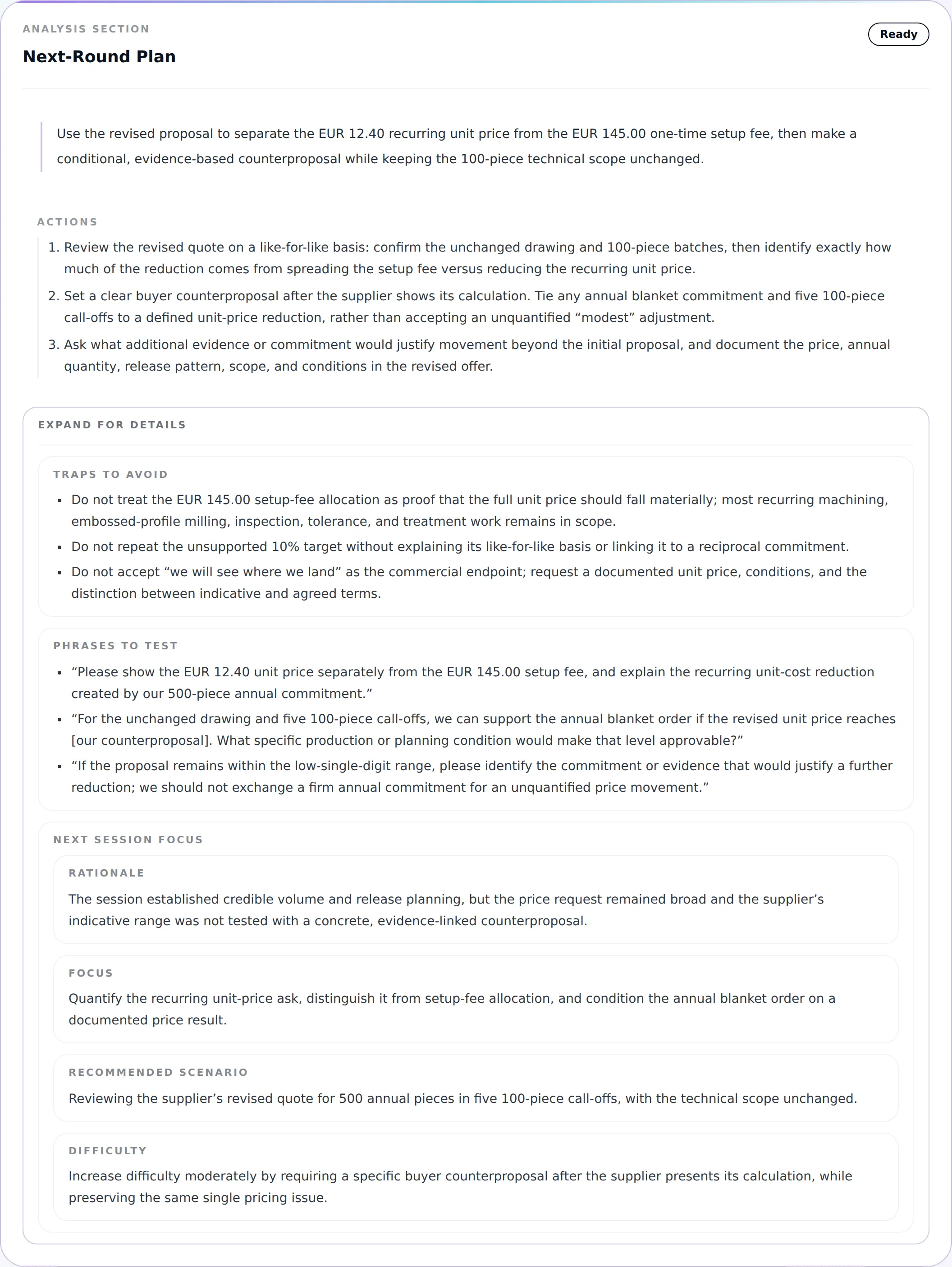
08 · Next round
Then a plan for the round that follows.
The report closes on actions, traps to avoid, phrases to test and a recommended scenario with a difficulty adjustment, so the next session starts where this one stopped.
From the report Use the revised proposal to separate the EUR 12.40 recurring unit price from the EUR 145.00 one-time setup fee, then make a conditional, evidence-based counterproposal while keeping the 100-piece technical scope unchanged.
Boundaries
What the analysis is, and what it is not.
It shows
Conversation behaviour, turning points and unused leverage, with the evidence for each.
It does not
Rank people, judge suitability or recommend decisions on hiring, promotion or pay.
People decide
What to buy, accept, concede or approve stays with the team.
Beyond one session
From one report to a team view.
Across sessions the same scored behaviours roll up into an aggregate capability report. A metric only appears once at least five different people have practised within a month; below that, the report says “not enough data” instead of showing zero.
How teams use it →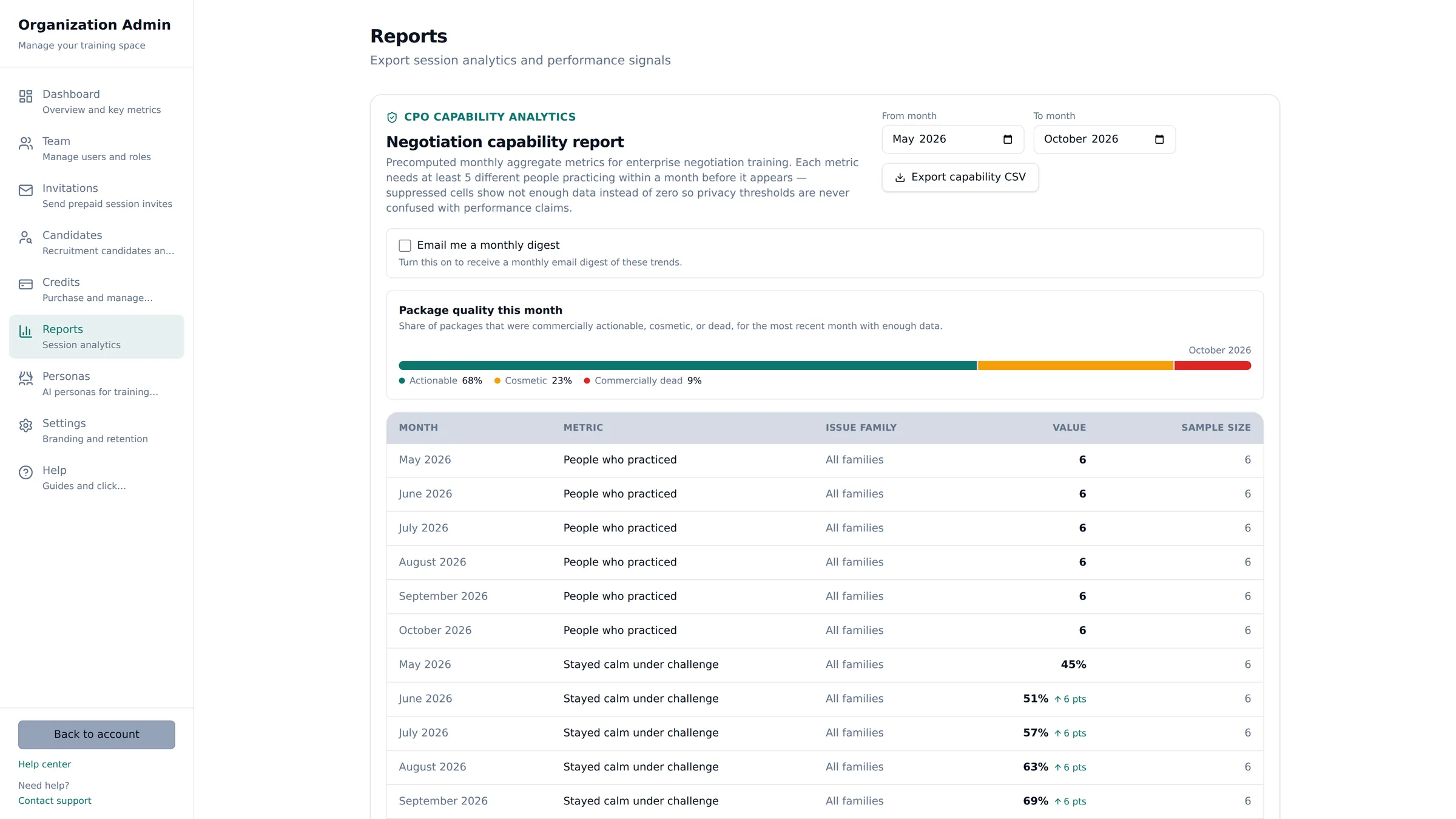
Read the report of your own round.
Run one real supplier situation through a round and you receive a report of this shape, about a minute after the session ends.
The report shown is from one recorded practice round on a fictional case, run on the demo account; names, figures and the quotation are test material. The team view shows demonstration data, not customer results.